AI AGENTS
45 SRC
AI Agents
.agents/skills/ directory convention) is becoming the standard for packaging domain expertise as agent-consumable documentation. The consensus is shifting from single powerful agents to orchestrator agents managing teams of sub-agents, with coordination -- not intelligence -- as the bottleneck. A deeper theoretical foundation is emerging: frontier reasoning models spontaneously generate "societies of thought" — internal multi-agent debates that causally drive accuracy — suggesting intelligence is inherently social, not individual. Each prior intelligence explosion (language, writing, institutions) was the emergence of a new socially aggregated unit of cognition, and LLMs represent the cultural ratchet made computationally active. The path forward runs through composing richer human-AI social systems ("centaurs" in shifting configurations), not building a single colossal oracle. Always-on background agents running via launchd or cron deliver daily briefs, meeting prep dossiers, and weekly coaching conversations. Cost optimization through hierarchical model routing (80% of tasks are janitorial and can run on cheap models) achieves 10x savings. Agent memory patterns -- scratchpads, self-logging, self-improving skill systems -- are creating compounding improvement across sessions. Specialized agent products are emerging in finance (Dexter), sales (agent-driven outbound replacing SDR teams), marketing (Okara's AI CMO), and agency operations. AI-native workspaces (Core) are rebuilding Slack + Linear + Notion as unified agent-friendly platforms. Agent governance is emerging as a constitutional design problem — AI systems with distinct invested values checking and balancing other AI systems. The UX frontier is conversation-native rendering, cognitive debt reduction, and human-AI interaction pattern libraries. MCP is becoming the standard integration protocol, with Linear, Anthropic, and others building plugin ecosystems.Guides
Designing a Second Brain for AI Agents: The Vault-as-Database Pattern
How to architect a local knowledge base that AI agents can reason over — starting from Karpathy's three-folder reference architecture, through the three-layer memory stack, MCP bridges, quality maintenance, and the scaling path from flat files to SQLite.
The Social Nature of AI Intelligence: From Societies of Thought to Agent Governance
Why intelligence is inherently social — how reasoning models spontaneously generate internal debates, why the singularity vision is wrong, the human-AI centaur era, and the constitutional design principles for governing billions of interacting agents.
Building Multi-Agent Orchestration Systems: From Single Agents to Coordinated Teams
A practical guide to designing agent coordination systems — covering orchestrator patterns, sub-agent delegation, cost optimization strategies, MCP tool integration, and the memory/self-improvement loops that make agent teams compound over time.
What Is Autoresearch and How to Use It
Autoresearch is Karpathy's hill-climbing optimization loop — make one change, test against a binary checklist, keep or revert, repeat. This guide covers the core method, practical implementation with Claude skills, scaling to parallel GPU clusters and distributed agent swarms, and the emerging pattern of full-stack AI research agents.
Claude & Claude Code for Marketing Agencies: A Detailed Guide
A comprehensive guide covering agency workspace setup, content strategy, competitive intelligence, outbound automation, brand design workflows, and agency-specific Claude Code skills — grounded in 77+ sources.
Insights
- Vercel Labs' agent-browser Electron skill lets AI agents control any Electron-based desktop app (Discord, Figma, Notion, VS Code), extending automation from browsers to the full desktop ecosystem (from agent browser electron skill)
- The
npx skills addpattern for agent capabilities mirrors package management for code, creating a composable skill ecosystem where agents gain abilities through one-line installs (from agent browser electron skill) - OpenClaw Studio provides open-source, self-hosted agent observability with real-time dashboards, live chat, approval gates, and cron scheduling -- enterprise-grade agent monitoring without the $500/month SaaS price tag (from openclaw studio agent dashboard)
- Approval gates (human-in-the-loop for dangerous actions) are becoming standard in agent management, reflecting that autonomous agents need explicit checkpoints before high-risk operations (from openclaw studio agent dashboard)
- WebSocket streaming for real-time agent visibility signals agents are increasingly long-running processes needing live dashboards similar to DevOps monitoring (from openclaw studio agent dashboard)
- Paperclip is an open-source orchestration layer for zero-human businesses, treating org charts, goal alignment, task ownership, and budgets as agent configurations rather than human processes (from paperclip autonomous business orchestration)
- Agent orchestration frameworks adopt business metaphors (org charts, goals) to make multi-agent coordination legible -- the abstraction for agent companies mirrors human organizational design (from paperclip autonomous business orchestration)
- ClawRouter scores each LLM request across 14 dimensions in under 1ms and routes to the cheapest capable model, cutting blended inference cost from $75/M to $3.17/M (from clawrouter llm smart routing)
- Routing tiers by task type: simple math to DeepSeek ($0.27/M), summarization to GPT-4o-mini ($0.60/M), code generation to Claude Sonnet ($15/M), formal reasoning to DeepSeek-R ($0.42/M) (from clawrouter llm smart routing)
- Matrix is a search engine trained on 100K+ crawled agents, skills, and tools that matches capabilities to tasks -- a discovery layer for the agent ecosystem that improves via a gossiping network (from matrix agent search engine)
- Hyperspace generalizes Karpathy's autoresearch loop into a platform where users describe optimization problems in plain English and the network spawns a distributed swarm to solve them with zero code (from hyperspace agi autoswarms)
- Autoswarms use evolutionary loops: LLM generates sandboxed experiment code, validates locally, publishes to P2P network, peers opt in, best strategies propagate via gossip inside WASM sandboxes (from hyperspace agi autoswarms)
- 237 agents with zero human intervention ran 14,832 experiments across 5 domains: ML agents drove validation loss down 75%, search agents evolved 21 scoring strategies, finance agents achieved Sharpe 1.32 (from hyperspace agi autoswarms)
- Research DAGs create cross-domain knowledge graphs where discoveries in one domain automatically generate hypotheses for others -- e.g., factor pruning improving Sharpe generates a hypothesis about pruning low-signal ranking features for search NDCG (from hyperspace agi autoswarms)
- Okara's "AI CMO" deploys a team of marketing agents from just a website URL, representing the trend of packaging multi-agent systems as role-specific products with near-zero onboarding friction (from okara ai cmo agent)
- 7 of the top 10 fastest-growing GitHub projects in a single week are agent-related, spanning skills frameworks (obra/superpowers at 100K stars), context databases (OpenViking), AI-native browsers (lightpanda in Zig), and design languages (Impeccable) (from fastest growing github ai agents)
- microsoft/BitNet -- the official framework for 1-bit LLMs achieving full performance at near-zero compute -- signals viability of extreme quantization for local agent inference on commodity hardware (from fastest growing github ai agents)
Agent Economy Infrastructure
- Companies building agent-economy primitives: agentmail (email), tryagentphone (phone), daytonaio/e2b (compute), browserbase/browser_use/hyperbrowser (browsing), firecrawl (crawling), mem0ai (memory), composio (SaaS), elevenlabs/vapi_ai (voice) -- stitching creates digital AI coworker (from an economy of ai coworkers)
Personal Automation with Subagents
- Claude Code subagents running in parallel with scoped tool access is the key capability enabling complex personal automation -- six independent workers holding different contexts simultaneously (from jimprosser chief of staff claude)
- Never let AI send emails autonomously (only draft), never make pricing decisions, default to "prep" (80% ready) rather than "dispatch" (fully handled) when uncertain (from jimprosser chief of staff claude)
- Layered automation compounds: overnight inbox scan improves morning triage, better triage enables subagent dispatch, reliable dispatch makes time-blocking viable -- 36 hours of work compounds on itself (from jimprosser chief of staff claude)
Orchestration and Multi-Agent Coordination
- The industry consensus is shifting from wanting a single powerful agent to wanting one coordinator agent that manages teams of sub-agents -- the "1 agent who runs teams of agents" mental model is becoming dominant (from agent orchestration coordination)
- Agent swarms fail not from technical limitations but from coordination failures: task assignment, deduplication, handoff, and human-in-the-loop monitoring are the unsolved UX problems (from agent orchestration coordination)
- Discord-as-OS pattern for agent orchestration: a coordinator spawns agents into structured channels, agents work in parallel and spawn sub-agents ("interns") for subtasks, then terminate them when done (from agent orchestration coordination)
- The winning agent orchestration solution likely will not come from a single AI lab -- it will be a mix of closed/open source models combined with deterministic orchestration logic (from agent orchestration coordination)
- The highest-leverage skill in agentic engineering is ascending layers of abstraction: setting up long-running orchestrator agents with tools, memory, and instructions that manage multiple parallel coding agent instances (from karpathy coding agents paradigm shift)
Always-On and Background Agents
- Running always-on AI agents via macOS launchd creates a "staff" that works asynchronously -- producing a daily brief by 9am without manual triggering, turning the OS scheduler into an agent orchestrator (from always on agents launchd obsidian)
- Using Obsidian as the documentation layer for agent outputs means all agent work products are stored in a human-readable, searchable, linked knowledge base rather than ephemeral chat logs (from always on agents launchd obsidian)
- A weekly AI coaching conversation that reviews meeting transcripts, task progress, and goal alignment represents a new pattern: agents as accountability partners, not just task executors (from always on agents launchd obsidian)
- An "AI-native agency OS" pattern is emerging where AI agents continuously scan client communication channels, auto-classify incoming work, assign it to team members, and suggest next steps in real time (from ai native agency os)
- The value proposition of agent-powered operations is shifting the team's role from triaging/organizing work to pure execution -- the AI handles intake, classification, routing, and prioritization (from ai native agency os)
Cost Optimization
- 80% of agent tasks are "janitorial" (file reads, status checks, formatting) and don't require frontier model intelligence -- this is the core insight behind hierarchical model routing (from hierarchical model routing cost)
- Hierarchical model routing by task complexity achieves ~10x cost reduction: DeepSeek ($0.14/M) for routine, Sonnet ($3/M) for moderate, Opus ($15/M) for hard -- dropping from $225/month to $19/month (from hierarchical model routing cost)
- The 80/15/5 distribution (routine/moderate/hard) for agent tasks suggests that even power users only need frontier reasoning for ~5% of their agent interactions (from hierarchical model routing cost)
Agent Memory and Self-Improvement
- The "napkin" pattern is a distinct form of agent context: not session history (lossy), not todos/plans (static), but a live working scratchpad the agent writes to as it thinks (from agent scratchpad napkin pattern)
- Agents that log their own mistakes, corrections, and what worked across sessions exhibit compounding improvement -- by session five, the tool behaves fundamentally differently (from agent scratchpad napkin pattern)
- Self-improving skill systems represent a key frontier for coding agents: instead of static skill libraries, the agent's repertoire evolves based on actual developer workflows (from self learning claude code skills)
- A one-line CLAUDE.md instruction can turn Claude Code into a persistent work logger, automatically maintaining a weekly recap file that accumulates as the agent completes tasks (from weekly recap agent memory)
Specialized Agent Products
- Dexter is an open-source AI agent that reached 10K GitHub stars, combining OpenClaw and Claude Code to automate financial research workflows: stock screening, financial breakdown, and thesis generation (from dexter finance ai agent)
- The finance vertical is proving to be a strong domain for AI agents -- structured data, clear evaluation criteria, and repeatable research workflows make it well-suited for agentic automation (from dexter finance ai agent)
- Specialized harnesses (designer, marketer, etc.) represent the next evolution: instead of one general-purpose agent, role-specific configurations tuned for different professional workflows (from claude code designer harnesses)
- Claude Code is being used as a full outbound sales platform: 11 APIs, 72 automation scripts, handling campaign strategy, list building, and outreach -- replacing traditional SDR teams (from claude code outbound sales agents)
- Agent-driven outbound flips the automation paradigm: instead of rigid workflow sequences, agents get tool access and figure out the execution path based on context and signals (from claude code outbound sales agents)
Agent UX
- Tool UI renders JSON tool outputs as inline, narrated, referenceable surfaces within chat messages -- solving the problem of agent results being dumped as raw text or hidden behind separate views (from tool ui react framework)
- "Conversation-native" is emerging as a design constraint: UIs optimized for chat width, scroll behavior, and inline rendering rather than traditional dashboard layouts (from tool ui react framework)
- The concept of "cognitive debt" from agent interactions is compelling: agents can do more, but if their output is hard to parse, the productivity gain is eroded by comprehension overhead (from visual explainer agent skill)
- Skills that control output format (not just task execution) represent a new category of agent customization -- shaping how the agent communicates, not just what it does (from visual explainer agent skill)
Human-AI Interaction Patterns
- The "AI Interaction Atlas" is a pattern library specifically for human-AI interaction design, signaling that AI UX is maturing enough to warrant its own dedicated design system (from ai interaction atlas)
- Human-centred AI design is becoming a distinct discipline, with practitioners creating shared vocabularies and reusable patterns rather than reinventing interaction models per product (from ai interaction atlas)
- Calendar-aware agents that schedule focus blocks based on existing commitments represent a shift from reactive AI assistants to proactive time-management agents (from cowork gsuite slack workflows)
- A practical agent automation pattern: cron trigger -> calendar API -> parallel research (Exa + Perplexity) -> Claude formatting -> email delivery, all orchestrated as a single pipeline (from meeting prep tool claude code)
Skills and Knowledge Distribution
The "skills as markdown" pattern is becoming a standard for AI agent extensibility — Corey Haines' marketingskills repo (17.4K stars) packages 36 marketing skills as
.mdfiles consumable by any agent (Claude Code, Codex, Cursor), proving domain knowledge distribution is a documentation problem, not a code problem (from marketing skills ai agents)A hierarchical skill architecture with a foundational context file (
product-marketing-context) that all other skills reference first ensures every AI marketing task starts grounded in the company's positioning and audience — not generic advice (from marketing skills ai agents)Cross-referencing skills bidirectionally (copywriting ↔ page-cro ↔ ab-test-setup) creates an interconnected knowledge graph within the agent, so optimizing a landing page automatically pulls in copy principles and testing methodology (from marketing skills ai agents)
The
.agents/skills/directory convention (migrated from.claude/) is emerging as a cross-platform standard for agent skill storage, with CLI, plugin marketplace, submodule, and SkillKit competing as distribution layers (from marketing skills ai agents)Specialized professional roles like senior design architecture are being packaged as custom agents for Claude, expanding beyond general-purpose assistants into domain-specific professional workflows (from claude senior design architect agent)
Open source browser automation tools designed specifically for AI agents are emerging as key infrastructure for web interaction and data gathering in agentic workflows (from browser automation agent tooling)
Cheng Lou's
@chenglou/pretextpackage enables developers to integrate AI into demo creation workflows — installable via npm/bun for immediate use (from pretext ai demo package)Index source documents in a raw/ directory then let LLMs incrementally compile a wiki of .md files with summaries, backlinks, and categorized concepts — LLM writes and maintains all wiki data, you rarely touch it directly (from llm powered personal knowledge bases)
Share abstract "idea files" (gist format) instead of specific code — other people's agents read the idea and customize/build implementations for their specific needs, enabling knowledge distribution without code maintenance burden (from llm personal knowledge base workflow)
Run LLM health checks over wikis to find inconsistent data, impute missing information with web searchers, and suggest new article candidates — agents that maintain their own knowledge base quality compounds over time (from llm powered personal knowledge bases)
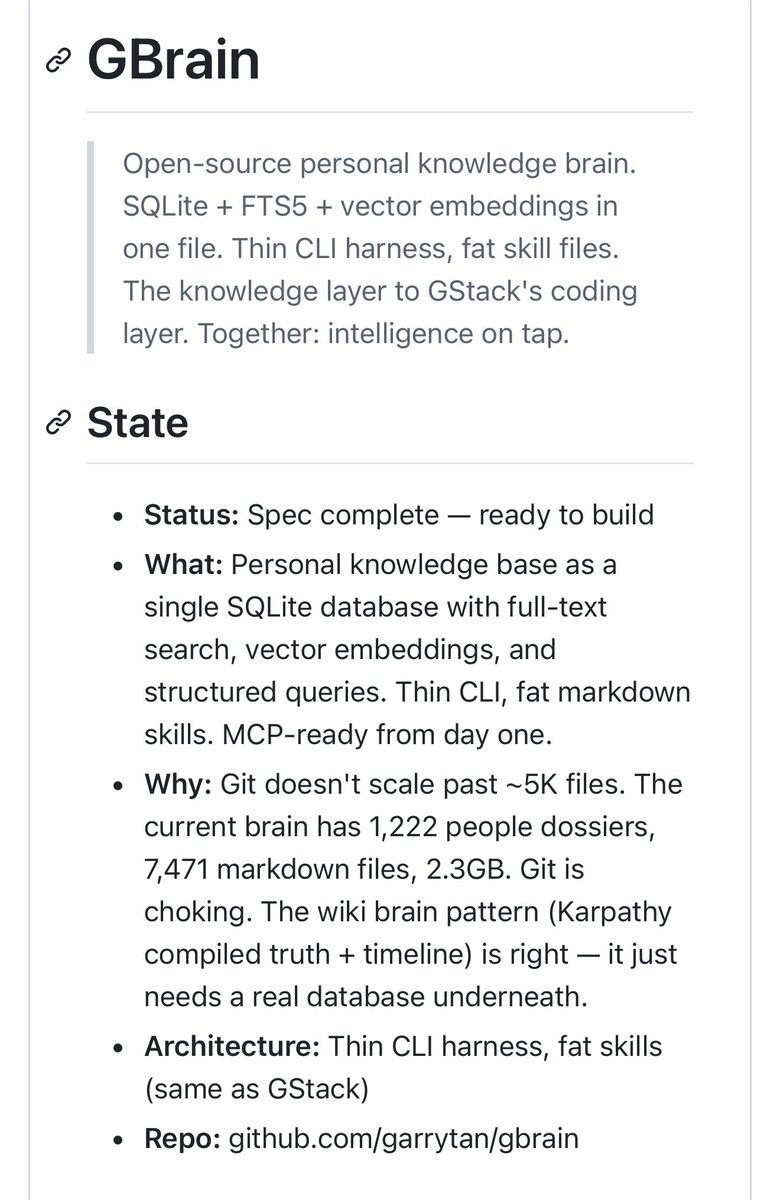
GStack autoplan skill generates architectural specs for upgraded systems (e.g., git wiki → SQLite GBrain) through single-line prompts, demonstrating agents as system architects not just implementers (from garry tan openclaw git wiki gstack)
Exo is an open source email client that uses Claude for automated inbox management — described as "Claude Code for your inbox," applying autonomous agent patterns to personal communication (from exo claude email client)
Single Brain architecture at Single Grain: unified vector DB ingesting all company data every 15 minutes; fleet of specialized agents (Alfred/ops, Arrow/sales, Oracle/SEO, Flash/content, Cyborg/recruiting) with a World Agent coordinator — 50+ daily cron jobs as the nervous system (from shared link without context)
Agent coordination conflicts are the biggest operational challenge: sales agent promises timelines SEO data contradicts, content agent uses deprioritized keywords, ops agent double-books time slots — required building explicit conflict resolution and security systems (from shared link without context)
DRI (Directly Responsible Individual) system applied to agent teams: spin up a temporary team around a specific goal, 90-day deadline, agents return to general pool when done, learnings absorbed into World Brain — failures improve the system too (from shared link without context)
Compounding curve for AI-native orgs: Month 1 terrible (hallucinations, 3am broken automations), Month 2 AutoResearch surfaces patterns humans missed (sales call keywords correlating with 3x close rates), Month 3 flywheel turns as accumulated data improves every agent's output (from shared link without context)
Months of continuous data ingestion creates a world model competitors need years to replicate — not because the tech is secret but because proprietary data accumulates in ways that can't be fast-forwarded; the data compounding IS the moat (from shared link without context)
agent-browser (Vercel Labs, 26K+ stars) lets AI agents scrape JavaScript-heavy sites, pages behind logins, and dynamic content using 82% fewer tokens than Playwright MCP — 5-6x more pages per session for knowledge base ingestion (from nick spisak shared link)
AI agents create decision checkpoints automatically: agent drafts a pricing proposal, human adjusts discount and adds reasoning note — the model's proposal is the structured prior, the human's edit is the judgment signal; tacit knowledge becomes observable (from ashugarg shared link)
Context amnesia is the fundamental agent problem: a 200K context window changes how much text the model can scan, not how much it "knows" — scanning is not knowing; without a memory system every session IS a first date (from nyk builderz shared link)
AI-Native Workspaces
- Core AI Workspace (Apache 2.0, free hosted) rebuilds Slack + Linear + Notion as a unified AI-native workspace, centralizing team context so small teams can work more efficiently with agents (from core ai workspace open source launch)
MCP and Tool Integration
- Linear's MCP server now includes product management capabilities, signaling that developer tools companies are expanding MCP integrations from engineering to cross-functional workflows (from linear mcp product management)
- MCP is becoming the standard protocol for tool vendors to integrate with AI coding agents -- Linear investing in Claude Code-specific demos signals MCP adoption reaching mainstream developer tools (from linear mcp product management)
- Anthropic open-sourced 11 domain-specific plugins spanning sales, finance, legal, data, marketing, and support -- vertical enterprise tooling is a key distribution strategy for AI platforms (from anthropic open source plugins)
- Skill architectures are converging across different agent platforms toward common patterns, as evidenced by guides written "for any coding agent" rather than Claude-specific (from building coding agent skills)
Intelligence as Social Process
- Frontier reasoning models (DeepSeek-R1, QwQ-32B) spontaneously generate "societies of thought" — internal multi-agent debates that causally account for their accuracy advantage on hard reasoning tasks, discovered through RL optimization alone without explicit training (from agentic ai intelligence explosion)
- Every prior intelligence explosion was the emergence of a new socially aggregated unit of cognition, not an individual upgrade — primate intelligence scaled with social group size, language created the cultural ratchet, writing externalized social intelligence into institutions (from agentic ai intelligence explosion)
- LLMs are the cultural ratchet made computationally active — every parameter is compressed communicative exchange, meaning what migrates into silicon is social intelligence in externalized form (from agentic ai intelligence explosion)
- The path to more powerful AI runs through composing richer social systems, not building a single colossal oracle — the monolithic singularity vision leads to policies aimed at preventing a technology that may never exist (from agentic ai intelligence explosion)
- Human-AI "centaurs" operate in shifting configurations: one human directing many agents, one AI serving many humans, many of each collaborating — agents can fork, differentiate into subtasks, and recombine results (from agentic ai intelligence explosion)
- The next intelligence explosion will be seeded by 8 billion humans interacting with hundreds of billions to trillions of AI agents — intelligence growing like a city, not a single meta-mind (from agentic ai intelligence explosion)
Voices
52 contributors

Siqi Chen
@blader
🏗️ Love to build (@runwayco @sandboxvr @zynga) people love 💸 Investor @amplitude_hq @mercury @owner @elevenlabsio @meetgamma @sfcompute @turingcom++
Andrej Karpathy
@karpathy
I like to train large deep neural nets. Previously Director of AI @ Tesla, founding team @ OpenAI, PhD @ Stanford.


Chris Tate
@ctatedev
@Vercel | Created agent-browser, json-render, portless | Husband & Dad | He/him | Musician, Space Nerd, Foodie | Vegan


Mike Fishbein
@mfishbein
Building custom AI agents and internal tools for marketing and sales teams.


Sharbel
@sharbel
Co-Founder https://t.co/G1eWKZtmi7. I help you build AI systems that work while you sleep.


Garry Tan
@garrytan
President & CEO @ycombinator —Founder https://t.co/7aoJjp1iIK—designer/engineer who helps founders—SF Dem accelerating the boom loop—haters not allowed in my sauna

Tom Dörr
@tom_doerr
Follow for posts about GitHub repos, DSPy, and agents Subscribe for top posts DM to share your AI project (Due to volume of DMs I'll prioritize subscribers)


Aakash Gupta
@aakashgupta
✍️ https://t.co/8fvSCtBv5Q: $72K/m 💼 https://t.co/STzr4nqxnm: $39K/m 🤝 https://t.co/SqC3jTyP03: $37K/m 🎙️ https://t.co/fmB6Zf5UZv: $30K/m

Cody Schneider
@codyschneiderxx
folllow for shiposting about the growth tactics i'm using to grow my startup building @graphed with @maxchehab Get Started Free - https://t.co/stXlkQBlSj


Ihtesham Ali
@ihtesham2005
investor, writer, educator, and a dragon ball fan 🐉

Adham Dannaway
@AdhamDannaway
📘 Author of @PracticalUI ⚡️ UX & UI design tips, inspiration, & news 🤟 Pushing pixels since 2005 ⚙️ Specialised in UI design & design systems


Okara
@askOkara
ai lab building products for consumers: AI CMO, Private AI Chat


Ole Lehmann
@itsolelehmann
I help non-technical people make more money with AI agents. AI connoisseur, robotics maxi, eu/acc supporter, dad, techno optimist


Morgan
@morganlinton
Cofounder/CTO @BoldMetrics - love building teams and software, in that order. Early @ Sonos, Engineering @ Carnegie Mellon. Not an expert - always learning.


Nick Spisak
@NickSpisak_
| AI Transformation Engineer | Seven Figure E-Commerce Business Owner


Sukh Sroay
@sukh_saroy
Sharing daily insights on AI, No Code, & Tech Tools • Follow me to master AI to level up your life • DM for Collabs


Cheng Lou
@_chenglou
Worked on: @reactjs, @messenger, @reasonml, @rescriptlang & @midjourney


zak.eth
@0xzak
👁️⃤ explorer in the further regions of experience ⃤⃟⃝ ㅤㅤ 𓆝 𓆟 𓆞 𓆝𓆝 𓆟 𓆞 𓆝ㅤㅤㅤㅤㅤ ☠︎︎ིྀ☠︎︎ིྀ☠︎︎ིྀ @numbergroupxyz ⫘⫘⫘ @ethcforg


Advait Paliwal
@advaitpaliwal
disciple of experience

Ankit Gupta
@agupta
general partner @ycombinator. co-founder of @reverielabs (acquired). @harvard CS. 🫶 to @lucylnam.


Aniket Panjwani
@aniketapanjwani
I teach agentic coding to economists || PhD Economics Northwestern || Director of AI/ML @ Payslice || ex-MLOps @ Zelle


Tanvir
@anjum_ai
Turning ideas into income with AI, SaaS & online biz. Sharing smart takes on productivity, entrepreneurship & product launches 📬 anjumtanvir095@gmail.com


ashu garg
@ashugarg
Enterprise VC @FoundationCap | Early investor in @databricks @tubi & 6 other unicorns- @cohesity @eightfoldai @turingcom @amperity @alation @anyscalecompute

Shruti Gandhi / Array VC preseed rounds
@atShruti
VC Eng @arrayvc Investor @happyrobot_ai @sapiomAI @placer_ai @daftengine @wabi @matic @joinallocate @runable_hq @drata @pendoio


Blake Anderson
@blakeandersonw
✝️


Cathryn
@cathrynlavery
Founder @bestselfco ($55M+ bootstrapped). Sold to PE in 2022. Bought it back 2024. Becoming AI Native & documenting @ https://t.co/lOWxGF3Rho


Claude
@claudeai
Claude is an AI assistant built by @anthropicai to be safe, accurate, and secure. Talk to Claude on https://t.co/ZhTwG8d1e5 or download the app.


Darrin Henein
@darrinhenein
Chief Design Officer at @Owner. Prev VP of Design @Shopify. Creator of @LastronautGame and @CanazeeGames.


𝒅𝒆𝒏𝒊𝒛𝒆𝒏
@dennizor
in search of a humane, universal interface


dotta 📎
@dotta
Paperclip Maximizer, Agent Orchestrator, Forgotten Runes, --dangerously-skip-permissions

ericosiu
@ericosiu
Founder- revenue agents @ singlebrain, ad agency @singlegrain, Investor. Member: @YPO Beverly Hills Podcaster: Marketing School, Leveling Up


Tw93
@HiTw93
Creator of Kaku · Mole · Pake · MiaoYan


hoeem
@hooeem
helping you turn screen time into cash flow using modern stacks to create digital leverage.


Ivan Boroja
@ivanboroja
Founder @_artasaka | The creative department for startups in the AI era.


James Bedford
@jameesy
engineering @zerion, building https://t.co/3RQYuZAcrt

jenny wen
@jenny_wen
generalist, realist, escapist. designer.


Linear
@linear
The product development system for teams and agents.

Michael Bloch
@michaelxbloch
Partner @QuietCapital. Previously founded Pillar (acquired by @Acorns) + early @DoorDash. Tweets about startups, tech, AI, and investing.

Mike Murchison
@mimurchison
CEO of Ada (@ada_cx), the agentic customer experience company. I usually post about applied AI and reflections on leadership. Made in Canada🇨🇦

Mitchell Hashimoto
@mitchellh
Working on a new terminal: Ghostty. 👻 Prev: founded @HashiCorp. Created Vagrant, Terraform, Vault, and others. Vision Jet Pilot. 👨✈️


Nico Bailon
@nicopreme
Building open source agentic tools, mostly for Pi coding agent.


Nyk 🌱
@nyk_builderz
co-founder @builderzdotdev | founder @splitlabsio | member @superteamDE | building AI agents + solana apps | open source | DM for builds.


Orca IDE
@orca_build
A cross-platform AI Orchestrator for the 100x devs

rahul
@rahulgs
head of applied ai @ ramp


Rohit
@rohit4verse
Engineer who builds, solves, and ships | FullStack + Applied AI | Agentic AI |


Ryan Carson
@ryancarson
Dad, Dev, CEO, 4x Founder.


Sara Du
@saradu
founder @andocorporation ✶ harvard dropout, thiel fellow, etc. likes agents & linguistics


Shiv
@shivsakhuja
Pontificating... / Vibe GTM-ing / Making Claude Code do non-coding things building a team of AI coworkers @ Gooseworks / prev @AthinaAI /@google / @ycombinator


Patrick Coddou
@soundslikecanoe
Teaching machines to work so humans can create. Operations / AI at AJF Growth (Meta Agency) Previously founder at @getsupply (acquired) Rarely serious.


Harmanjot Kaur
@sukhdeep7896


Varun
@varun_mathur
Agentic General Intelligence @HyperspaceAI (Co-founder and CEO)


Virat Singh
@virattt
Founder @findatasets, market infra for your agents.