OBSIDIAN
8 SRC
Obsidian
Guides
Insights
Obsidian Headless now supports Publish so you can publish to your website without using the Obsidian desktop app, and Sync has a headless client for server-side vault automation (from obsidian headless publish sync)
Obsidian + Claude Code is a recognized community pattern — the "vault as foundation, Claude Code as engine" architecture uses plain text markdown that any AI agent can read directly (from dev browser sawyerhood)
Use Obsidian Web Clipper extension to convert web articles to .md files; set up a hotkey to download all related images locally so LLMs can reference them in knowledge compilation (from llm powered personal knowledge bases)
Use Obsidian as the IDE frontend where you view raw data, the compiled wiki, and derived visualizations — LLM writes and maintains all wiki data, humans rarely touch it directly (from llm powered personal knowledge bases)
Marp plugin in Obsidian renders LLM outputs as slide shows; filing query results back into the wiki means every exploration enhances it for future queries — the wiki compounds through use (from llm powered personal knowledge bases)
In the LLM agent era, share abstract "idea files" (gist format) instead of specific code — another person's agent reads the idea and customizes/builds it for their specific needs, keeping it intentionally vague enough to support many directions (from llm personal knowledge base workflow)
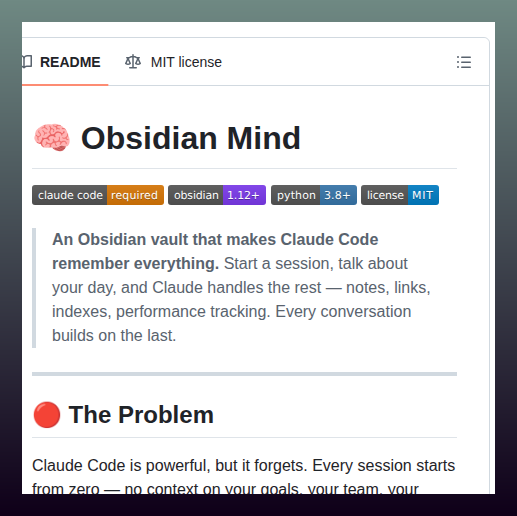
Obsidian vault purpose-built for Claude Code memory (obsidian-mind project) — combines Obsidian's knowledge management with persistent coding context across sessions (from obsidian vault claude code memory)
Two MCP servers bridge Claude and Obsidian vault: smart-connections (semantic search over entire vault — finds notes without exact titles) and qmd (structured queries, collection management, metadata operations for precise retrieval by path or tag) (from nyk builderz shared link)
brain-ingest tool processes video/audio locally (no data leaves machine), extracting 12-18 claims, 3-5 frameworks, 5-8 techniques from a single 90-minute talk — structured knowledge notes vs. raw transcript noise, dropped into vault inbox for review (from nyk builderz shared link)
Agents handle the maintenance that killed every wiki — they notice contradictions between notes, specs out of sync with codebases, and propose structural changes to the system itself when current architecture creates drag (from nyk builderz shared link)
Voices
7 contributors

Andrej Karpathy
@karpathy
I like to train large deep neural nets. Previously Director of AI @ Tesla, founding team @ OpenAI, PhD @ Stanford.

Tom Dörr
@tom_doerr
Follow for posts about GitHub repos, DSPy, and agents Subscribe for top posts DM to share your AI project (Due to volume of DMs I'll prioritize subscribers)


Nick Spisak
@NickSpisak_
| AI Transformation Engineer | Seven Figure E-Commerce Business Owner

Nick Khami
@skeptrune
currently doing things at Mintlify, prev. built a search API (trieve acq. YCW24), you should try to fail faster


Nyk 🌱
@nyk_builderz
co-founder @builderzdotdev | founder @splitlabsio | member @superteamDE | building AI agents + solana apps | open source | DM for builds.


Obsidian
@obsdmd
The free and flexible app for your private thoughts. For help and deeper discussions, join our community: https://t.co/1RE4oF63hR


Orca IDE
@orca_build
A cross-platform AI Orchestrator for the 100x devs